
The Best Debt Payoff Excel Templates and Methods for a Fresh Start
Why a Debt Snowball Method Calculator Changes Everything About Paying Off Debt
A debt snowball method calculator is a free planning tool that shows you exactly when each of your debts will be paid off — and when you’ll be completely debt-free — by simulating month-by-month payments starting with your smallest balance first.
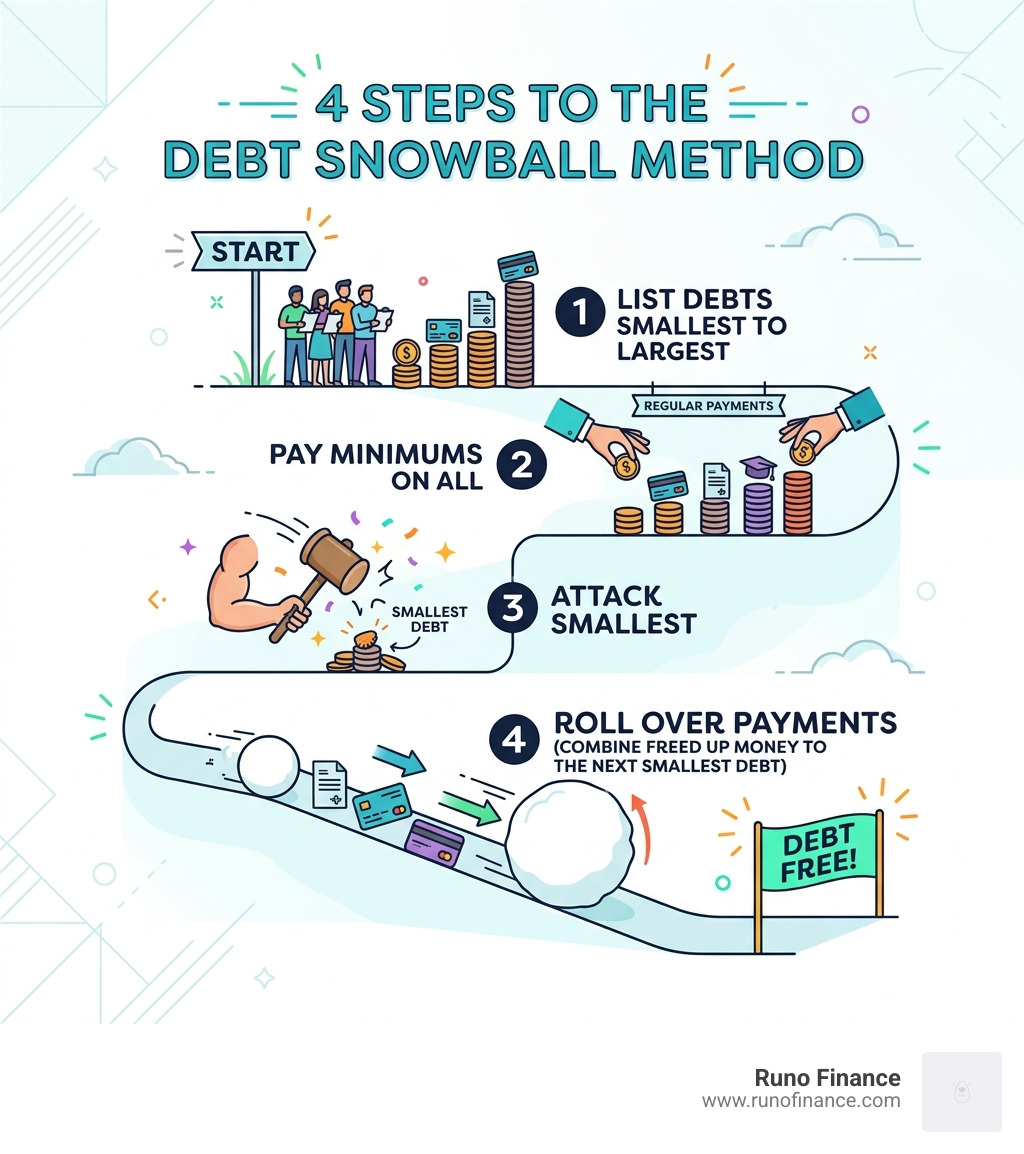
Here’s how it works in four steps:
- List all your debts from smallest balance to largest
- Enter each debt’s balance, interest rate, and minimum payment into the calculator
- Add any extra monthly amount you can afford to put toward debt
- The calculator shows your debt-free date and the order in which each debt gets eliminated
The “snowball” part happens automatically: once your smallest debt is gone, its payment rolls over to the next one — making each payoff faster than the last.
Debt is stressful. Most people know they need to pay it off faster, but they don’t know where to start or how long it will actually take. That uncertainty keeps a lot of people stuck.
The debt snowball method flips that script. Instead of tackling the biggest or most expensive debt first, you start small. You get a real win fast. That win builds confidence. Confidence builds momentum. And momentum — not math — is what actually gets most people debt-free.
Research from the Kellogg School of Management and the Harvard Business Review both support this. People who pay off smaller debts first are significantly more likely to eliminate all their debt, even if they pay a little more in total interest along the way.
Millions of people have used this approach to pay off $20,000–$50,000 in debt within 18–48 months of focused effort. That’s not a coincidence — it’s behavioral science at work.
A debt snowball calculator makes the whole process concrete. Instead of a vague goal like “pay off my debt someday,” you get a specific date. And a specific date changes everything.
What is the Debt Snowball Method and How Does it Work?
At its core, the debt snowball method is a debt reduction strategy where you pay off your debts in order of the smallest balance to the largest balance. We ignore interest rates for a moment—which might sound like financial heresy—but there is a very good reason for it.
When we use a debt snowball method calculator, we aren’t just looking for the cheapest way out; we are looking for the way that ensures we actually cross the finish line. By targeting the smallest balance first, you see a debt disappear quickly. That “quick win” triggers a psychological boost. You realize, “Wait, I can actually do this!”
The method works through a “rollover” effect. Imagine you have three debts:
- A $500 medical bill ($50 minimum payment)
- A $2,500 credit card ($100 minimum payment)
- A $7,000 car loan ($250 minimum payment)
In the beginning, you pay the minimums on everything except the $500 medical bill. You throw every extra dollar you can find at that $500 bill. Once it’s gone, you don’t just spend that $50 you used to pay. Instead, you “roll” it into the next debt. Now, you’re paying your original $100 minimum on the credit card plus the $50 from the medical bill, plus any extra cash. Your payments grow larger and larger, like a snowball rolling down a hill, gaining size and speed until it crushes the final, largest debt.
Debt Snowball Method Calculator vs. Debt Avalanche
If you’ve spent any time in personal finance forums, you’ve likely heard of the “Debt Avalanche.” This is the snowball’s more analytical cousin. While the snowball focuses on the lowest balance, the avalanche focuses on the highest interest rate.
Here is a quick breakdown of how they compare:
| Feature | Debt Snowball | Debt Avalanche |
|---|---|---|
| Primary Focus | Smallest Balance | Highest Interest Rate (APR) |
| Goal | Psychological Momentum | Mathematical Efficiency |
| Best For | People who need quick wins to stay motivated | Disciplined “math nerds” who want to save every penny |
| Completion Rate | Higher (Proven by HBR & Kellogg research) | Lower (Higher risk of losing steam) |
| Interest Saved | Slightly less | Maximum savings |
While the avalanche method is mathematically the “fastest” way to pay off debt on paper because it minimizes interest, it often fails in the real world. Why? Because if your highest interest debt is a $20,000 student loan and your smallest debt is a $400 credit card, the avalanche method will have you chipping away at that $20,000 monster for months or years without seeing a single “Paid in Full” notification. That is where people give up.
Why the Snowball Method Wins in Real Life
At Runo Finance, we believe that personal finance is 80% behavior and only 20% head knowledge. If it were just about math, none of us would have debt in the first place! We’d all just spend less than we earn.
The snowball method wins because it accounts for human emotion. A study published by the Harvard Business Review found that people using the snowball method pay off debt more reliably than those using the avalanche method. Another study from the Kellogg School of Management in 2012 confirmed that the sense of progress from clearing small balances is the single best predictor of whether someone will actually become debt-free.
When you use a debt snowball method calculator, you are planning for a behavioral change. You are building financial confidence one small victory at a time.
How to Use a Debt Snowball Method Calculator Effectively
Using a calculator isn’t just a “one and done” task. To get the most out of our tools, you need to treat the calculator as a living document. It’s your roadmap, and as we all know from April 2026 traffic, roadmaps need occasional updates.
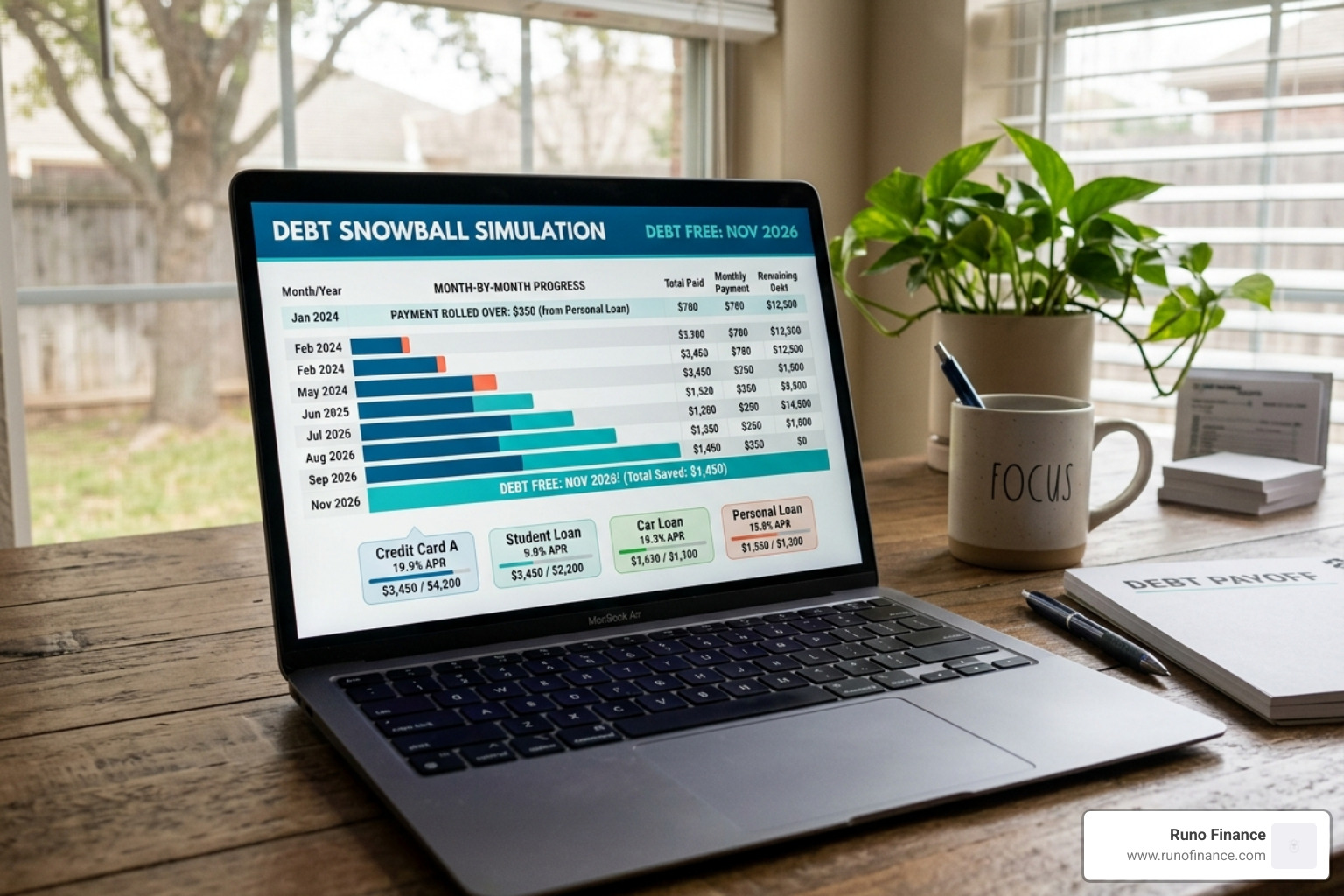
To use a debt snowball method calculator effectively, you should run a month-by-month simulation. This isn’t just about seeing a final date; it’s about seeing the “cascading” effect of your payments. Most calculators will show you exactly which month your first credit card will hit zero, and how that $150 payment will then “hop” over to your next debt.
Essential Inputs for Your Debt Snowball Method Calculator
To get an accurate debt-free date, you need to be precise with your data. Don’t guess. Pull up your latest statements (digital or paper) and gather the following:
- Creditor Name: Keep it clear (e.g., “Blue Bank Visa” vs. “Credit Card”).
- Current Balance: The exact amount you owe today.
- Interest Rate (APR): Even though we sort by balance, the calculator needs this to calculate how much of your payment goes to interest vs. principal.
- Minimum Monthly Payment: The absolute lowest amount you must pay to stay in good standing.
- Extra Monthly Amount: This is the “secret sauce.” This is the additional money you can squeeze out of your budget—whether it’s $50 or $500—to accelerate the process.
Interpreting Your Debt-Free Date Results
Once you hit “calculate,” the results can be life-changing. You’ll see a specific month and year—perhaps October 2028—when you will be completely free.
But don’t just look at the date. Look at the Total Interest Saved. Most people are shocked to see that by adding just $100 extra a month, they might save $5,000 in interest and shave two years off their timeline. This visualization is what keeps you from buying that unnecessary gadget when you’re tempted. You aren’t just “saving money”; you’re buying back two years of your life.
Step-by-Step Guide to Building Your Payoff Plan
Ready to start? Let’s walk through the Runo Finance guide to building a plan that actually sticks.
Step 1: The “Four Walls” Budget Before you throw extra money at debt, ensure your “Four Walls” are covered: Food, Utilities, Shelter, and Transportation. If you can’t eat or keep the lights on, you can’t pay off debt.
Step 2: Build a Starter Emergency Fund We recommend saving $1,000 to $2,000 before starting the snowball. Why? Because life happens. If your tires blow out in May 2026 and you don’t have cash, you’ll just put it on a credit card and break your momentum. The emergency fund is your “debt insurance.”
Step 3: List and Sort List every non-mortgage debt. We usually exclude the mortgage here because it’s such a large, low-interest balance that it can kill the “quick win” vibe of the snowball. Sort them from smallest balance to largest.
Step 4: Find Your “Extra” Look at your spending. Can you cut a streaming service? Can you meal prep? Even small amounts matter. As one of our favorite stats shows, adding just $25 or $50 a month can shave months off a payoff date.
Step 5: Execute and Rollover Pay the minimums on everything except the smallest. Attack that smallest one with everything you’ve got. When it’s gone, celebrate! Then, take that entire payment and move to the next one.

Managing Rollover Payments and Momentum
The transition period—when one debt is paid off and you move to the next—is the most dangerous time for your plan. It is very tempting to take that “freed up” $100 and go out to dinner.
Don’t do it.
The power of the debt snowball method calculator is the mathematical acceleration of the rollover. To manage this effectively:
- Automate: As soon as a debt is paid, update your auto-pay for the next debt in line.
- Track Progress: Use a visual tracker on your fridge. Color it in as you go.
- Celebrate Small: When you finish a debt, have a “free” celebration—a movie night at home or a hike. Acknowledge the win without breaking the budget.
Common Mistakes to Avoid in Your Debt Payoff Journey
Even with the best debt snowball method calculator, pitfalls exist. We’ve seen thousands of people start strong and then stumble. Here is how to avoid the “debt traps”:
- Taking on New Debt: This sounds obvious, but you can’t get out of a hole while you’re still digging. Freeze your credit cards (literally, in a block of ice if you have to) to stop the bleeding.
- Closing Paid-Off Accounts Immediately: While it’s tempting to “cancel” the card that caused you pain, closing your oldest accounts can actually hurt your credit score by reducing your “length of credit history.” It’s often better to keep them open but hidden.
- Ignoring Interest Rates Entirely: While we sort by balance, if you have two debts with similar balances—say $1,000 and $1,100—and the $1,100 one has a 29% APR while the other is 0%, it’s okay to tweak the order slightly to save on that high interest.
- Depleting Your Emergency Fund: Never use your last $1,000 to pay off a debt. If a real emergency hits, you’ll be forced back into the debt cycle.
- Setting an Unsustainable Pace: It’s better to pay $200 extra every month for three years than to pay $1,000 extra for two months and then quit because you’re miserable.
Frequently Asked Questions about Debt Snowballing
Should I include my mortgage in a debt snowball plan?
Generally, no. Most financial experts, including the team at Runo Finance, suggest focusing on “consumer debt” first—credit cards, car loans, student loans, and medical bills. Mortgages are usually much larger and have lower interest rates. If you include a $300,000 mortgage in your snowball, you’ll be stuck on that “step” for decades, which defeats the purpose of the psychological momentum. Tackle the mortgage after you are otherwise debt-free and have a full emergency fund.
What if I can’t afford all my minimum payments?
If you are in a position where you can’t even cover the minimums, a debt snowball method calculator is the second step. The first step is survival. Contact your creditors immediately. Many have “hardship programs” that can temporarily lower your interest or payments. You might also look into nonprofit credit counseling. Once your budget is stabilized, then you can start the snowball.
How often should I update my debt snowball method calculator?
A monthly rhythm is best. Every time you sit down to pay bills (or check your automated payments), update the balances in your calculator or Excel template. Seeing the numbers drop every 30 days provides the “dopamine hit” you need to stay focused for the next month.
Can the debt snowball work with more than 10 debts?
Absolutely. In fact, the more debts you have, the more you need the snowball method. If you have 15 different small medical bills and credit cards, you likely feel overwhelmed. The snowball method simplifies your life by giving you only one target at a time.
Is the debt snowball method backed by research?
Yes. As mentioned earlier, Harvard Business Review and the Kellogg School of Management have both found that the “small wins” strategy is more effective for long-term success than the “highest interest” strategy. It turns out that humans are not calculators; we are emotional beings who need to see progress to stay committed.
Conclusion
At Runo Finance, we know that the journey to debt freedom isn’t just about numbers on a screen—it’s about reclaiming your life. Whether it’s April 2026 or years into the future, the principles of the debt snowball remain the same: focus, momentum, and consistency.
By using a debt snowball method calculator, you take the guesswork out of your financial future. You stop wondering “if” you’ll be debt-free and start planning for “when.” It’s a simple, trustworthy way to manage your money with confidence.
The hardest part is simply starting. List that first small debt today, find an extra $20 in your budget, and watch as that tiny snowball eventually turns into an avalanche of financial freedom.
