
Your Phone is a Vault with the Best Budgeting App 2026 Edition
The Best Personal Money Apps in 2026: Quick Answer
A personal money app is one of the most effective tools you can use right now to stop overspending, build savings, and finally feel in control of your finances.
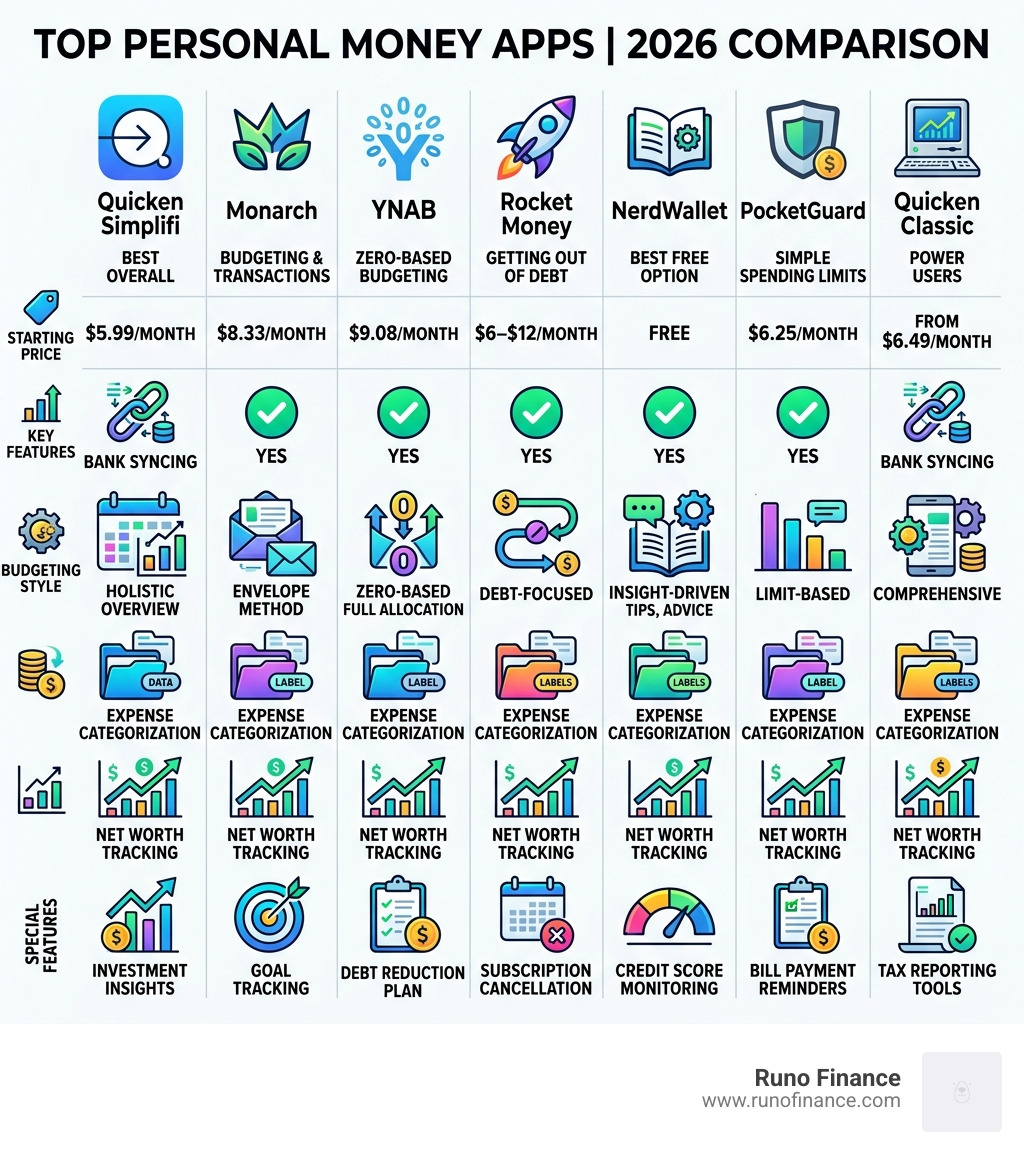
If you just want the short answer, here are the top categories for 2026:
| App Category | Best For | Starting Price |
|---|---|---|
| Comprehensive Budgeting | Best overall | $5.99/month |
| Transaction Focused | Budgeting & transactions | $8.33/month |
| Zero-Based | Giving every dollar a job | $9.08/month |
| Debt Management | Getting out of debt | $6-$12/month |
| Basic Tracking | Best free option | Free |
| Simple Spending | Spending limits | $6.25/month |
| Power User Tools | Advanced users | From $6.49/month |
Here’s the thing most people don’t realize: your phone is already capable of being a full financial command center. You just need the right app to unlock it.
Personal finance apps have improved dramatically over the past 15+ years. Today’s best options connect to thousands of bank accounts, categorize your spending automatically, and even use AI to flag problems before they become expensive habits.
Whether you’re living paycheck to paycheck or just want a clearer picture of where your money goes, there’s an app built for exactly where you are right now.
This guide breaks down the best options for April 2026 – what they cost, who they’re built for, and what makes each one worth your time.
Choosing the Right Personal Money App for Your Goals
Selecting a personal money app isn’t just about finding the one with the prettiest icons. It’s about matching a tool to your specific financial psychology. Are you someone who wants to account for every single penny, or do you just want a “safe-to-spend” number so you don’t overdraw your account at the grocery store?
In 2026, the best apps focus on three pillars: transaction management, categorization, and net worth tracking. Transaction management ensures that every coffee purchase or subscription renewal is accounted for in real-time. Categorization helps you see the “big picture”-like realizing you spent more on streaming services last month than on actual groceries. Finally, net worth tracking connects your bank accounts, loans, and investments to show you the “bottom line” of your financial health.
Scientific research from organizations like the APA consistently shows that financial stress is a leading contributor to poor physical health and anxiety. By using a digital tool to gain clarity, you aren’t just managing numbers; you’re actively reducing the mental load that comes with financial uncertainty. When you can see your progress toward a goal, your brain releases dopamine, making the act of saving money feel just as rewarding as spending it.

Finding a Personal Money App for Beginners
If you’re new to this, the last thing you want is a spreadsheet that looks like it belongs in an accounting firm. Beginners should look for apps that offer an automated setup. This means the app does the heavy lifting by connecting to your bank and automatically sorting your past 30 days of spending into categories.
We recommend looking for apps that utilize “Spending Plans” rather than rigid budgets. A spending plan is more flexible; it tracks what you’ve earned and what you’ve spent in real-time “buckets.” Many top-tier apps offer a 30-day free trial. This is a perfect window for financial app novices to see if the interface clicks with them without any upfront financial commitment. The goal for a beginner is to build a habit, not to become an overnight expert.
Advanced Personal Money App Features for Power Users
On the other end of the spectrum are the “power users.” These are the folks who want to micromanage every transaction, split a single Amazon receipt into five different categories, and track their IRS Schedule C expenses.
For 1099 workers and gig economy professionals, advanced budgeting tools are a godsend. They allow you to tag transactions for tax purposes, making it much easier to hand off data to an accountant at the end of the year. Power users also demand granular forecasting. They don’t just want to know what they spent today; they want to see a projection of their bank balance six months from now based on their current savings rate and bill schedule. If you have a complex portfolio, look for apps that offer robust investment tracking and the ability to handle multiple currencies or international bank feeds.
Top Features to Look for in 2026
The landscape of personal finance has shifted. We’ve moved past simple expense logging into the era of “intelligent” money management. Here is a breakdown of what you should expect from a premium personal money app versus what you get for free:
| Feature | Free Apps | Premium Apps |
|---|---|---|
| Account Syncing | Basic / Limited institutions | Deep connectivity (13,000+ banks) |
| Budgeting Style | Passive tracking | Active (Zero-based / Envelope) |
| AI Support | None or basic alerts | AI Assistants (Natural Language) |
| Ads | Often high (Credit card offers) | Ad-free experience |
| Support | Self-service / Help articles | Priority email or live chat |
One of the most effective methods supported by modern apps is “zero-based budgeting” or the “envelope method.” This philosophy, championed by leading zero-based budgeting tools, requires you to “give every dollar a job.” You aren’t just tracking what happened; you’re deciding what will happen with every cent you own before you spend it.
Additionally, look for innovative tools like “Spending Watchlists.” These allow you to keep a close eye on specific categories where you tend to overspend-like “Dining Out” or “Online Shopping”-without having to look at your entire budget every day.
Collaborative Tools for Households
Managing money is rarely a solo sport. Whether you’re married, living with a partner, or sharing expenses with a roommate, collaborative features are essential. Many apps now offer “Family Sync” or partner collaboration at no extra cost.
A collaborative personal money app allows two people to have separate logins but view the same “household” pool of money. This eliminates the “Did you pay the electric bill?” conversations and replaces them with shared goal-oriented saving.
Benefits of Collaborative Budgeting:
- Unified Vision: Both partners see the progress toward a house down payment or vacation fund.
- Accountability: It’s harder to overspend on “wants” when you know your partner is looking at the same dashboard.
- Transparency: All recurring subscriptions are visible, preventing duplicate payments for the same service.
- Safety Net: If one person handles the bills and something happens to them, the other has full access to the financial roadmap.
Innovative Forecasting and Goal Planning
The best apps in 2026 don’t just look backward; they look forward. Innovative forecasting tools allow you to “play” with your numbers. For example, “If I increase my 401k contribution by 2%, how does that affect my ability to pay off my car loan by December?”
Savings tracking has also become more granular. Instead of one big “Savings” account, apps let you create virtual sub-savings goals. You can see exactly how much of your bank balance is for your “Emergency Fund” versus your “New Laptop Fund.” Some premium apps even go a step further by offering bill negotiation services and subscription cancellation tools. They scan your transactions for recurring charges you might have forgotten about and can actually negotiate lower rates on your behalf for internet or phone bills.
Security and Connectivity: Keeping Your Vault Safe
We understand that the idea of linking your entire financial life to a single app can be intimidating. However, modern personal finance apps are built with “vault-grade” security. Your phone effectively becomes a secure gateway to your data without actually storing your bank login credentials on the device itself.
The industry standard for a personal money app in 2026 includes 256-bit encryption-the same level used by major banks. Furthermore, multi-factor authentication (MFA) is no longer optional; it is a requirement. This ensures that even if someone manages to get your password, they cannot access your financial data without a second form of verification, like a fingerprint or a code sent to your secure device.
At Runo Finance, we believe that financial management should be as safe as it is simple. Our mission is to provide you with the tools to manage your money with total confidence. You can learn more about our mission and our commitment to your financial well-being here.
Account Connectivity and Data Integrity
The “magic” of a personal money app comes from its ability to talk to your bank. Most top-tier apps use aggregators like Plaid to connect to over 17,000 financial institutions. This ensures real-time updates. When you swipe your card at a cafe, the transaction should appear in your app almost instantly.
This connectivity also allows for “Transaction Review” features. This is a powerful habit where the app flags new transactions and asks you to “approve” or “categorize” them. This manual touchpoint, combined with automated syncing, ensures high data integrity. It also serves as a brilliant fraud detection tool; if a charge appears that you don’t recognize, you can catch it and alert your bank immediately.
Privacy Protocols in the AI Era
As AI becomes more integrated into our apps, privacy protocols have had to evolve. Modern apps use AI assistants to monitor your spending, but they do so using encrypted data. When looking for an app, check their data collection policy. You want an app that uses your data to improve your experience, not one that sells your spending habits to third-party advertisers.
Biometric protection (FaceID or TouchID) adds an extra layer of local security. Even if you hand your unlocked phone to a friend to show them a photo, they won’t be able to open your money app without your face or fingerprint. Some premium apps even offer identity monitoring and dark web scanning, alerting you if your personal information appears in places it shouldn’t be.
Frequently Asked Questions about Personal Money Apps
Are there any free personal finance apps worth considering?
Absolutely. There are several excellent free options available on the market today. Some have even “reimagined” many of the beloved features from classic budgeting tools, such as net worth tracking and spending categorization. However, keep in mind that free apps often make money by showing you “recommendations” for credit cards or loans. If you want a completely ad-free experience with more robust budgeting tools, a paid subscription is usually worth the investment.
How do AI assistants benefit my budget?
AI assistants act like a digital financial coach. Instead of you having to dig through charts, you can ask the AI, “How much did I spend on groceries this month compared to last?” or “Can I afford a $200 dinner tonight?” These tools can also automate your savings by identifying small amounts of “extra” money in your checking account and moving it to a high-yield savings account for you.
Is it safe to link my bank accounts to a mobile app?
Yes, provided you use a reputable app that employs 256-bit encryption and MFA. Most apps use “read-only” access, meaning they can see your transactions to categorize them, but they cannot actually move your money or change your account settings. Always ensure the app you choose has a clear privacy policy and uses a trusted third-party connector like Plaid.
Conclusion
Managing your money doesn’t have to be a source of constant dread. In April 2026, the technology available in a personal money app is more powerful, secure, and user-friendly than ever before. Whether you choose the granular control of a zero-based system, the automated ease of a comprehensive tracker, or the collaborative power of a shared platform, the most important step is simply to start.
At Runo Finance, we are dedicated to helping you achieve financial simplicity. We believe that when you have a clear view of your money, you have a clear view of your future. By turning your phone into a financial vault, you’re not just tracking expenses-you’re building the foundation for a life of confidence and freedom.
Ready to take the next step in your financial journey? Visit us at https://www.runofinance.com/ to discover more tips and tools for straightforward, trustworthy financial management.
